The Caribbean in 1702: the history behind the game
Privateer begins in June 1702, a few weeks after England and the Dutch Republic declared war on France and Spain. This page sets out what was happening in the West Indies at the time, and which parts of it you will meet in the game.
Play Privateer now Free. Runs in your browser. Nothing to install.
Why there was a war
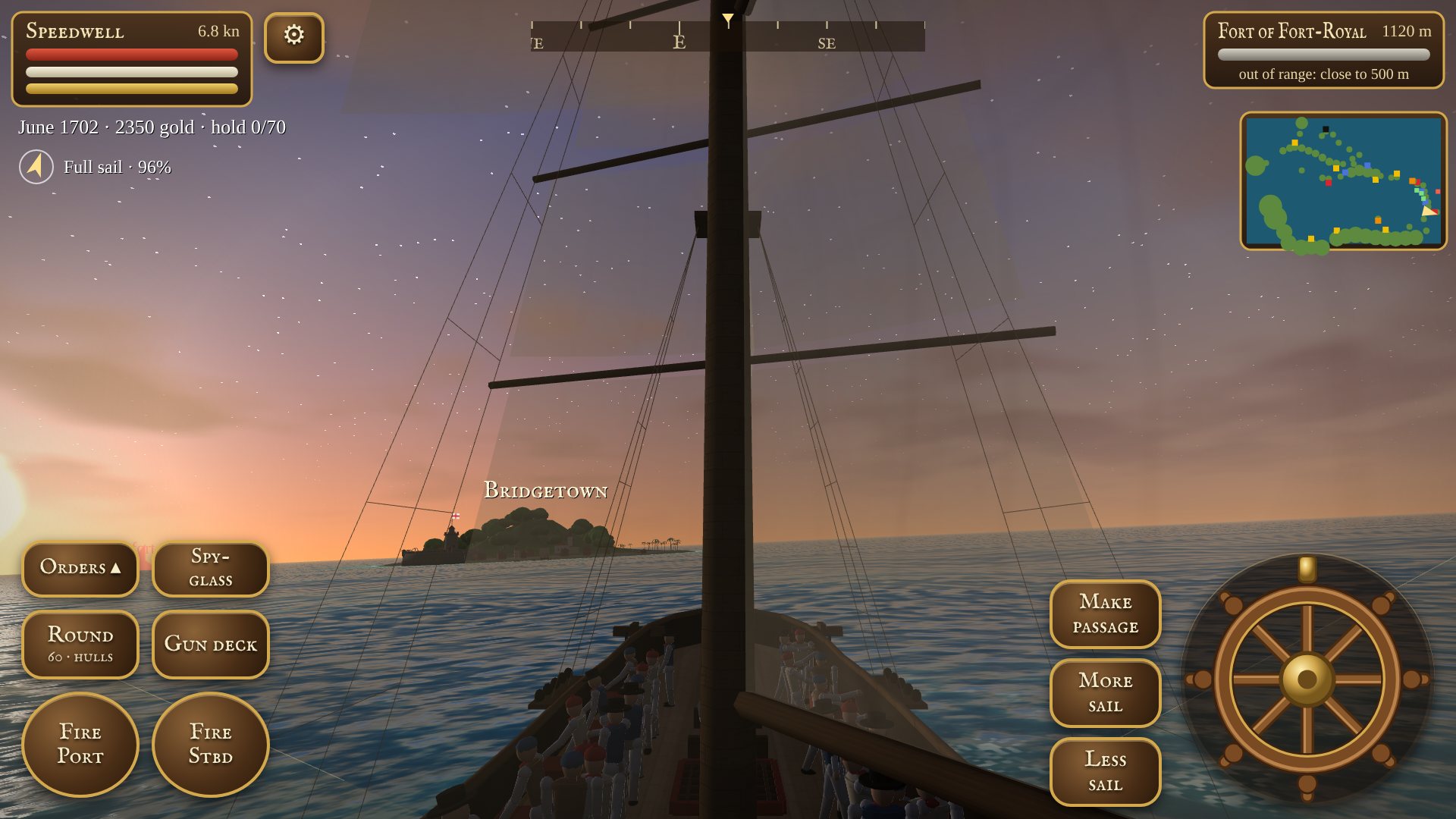
Charles II of Spain died in November 1700 without an heir. His will left the whole Spanish empire to Philip of Anjou, a grandson of Louis XIV of France. England, the Dutch Republic and Austria would not accept French power joined to Spanish silver, and in May 1702 they declared war. In Europe it is called the War of the Spanish Succession. In the English colonies it was Queen Anne's War.
In the Caribbean the lines were simple. English and Dutch ships fought French and Spanish ones. The game lets you sail for any of the four.
What a privateer was
A privateer was a privately owned warship with a commission from her government, called a letter of marque, which allowed her to capture enemy merchant ships in wartime. The owners fitted her out at their own cost and hoped to be repaid from what she took. The crew usually served for shares of the prize money and no wages.
The commission was the difference between a privateer and a pirate. A capture had to be brought before an admiralty court, which examined the ship's papers and decided whether she was a lawful prize. Only then could she and her cargo be sold. A captain who took a neutral ship, or one of his own side, could lose the prize and his commission with it.
In the game this is why you send prizes in to a court, why your owners at home have opinions about how you spend your time, and why firing on a friendly flag has consequences.
The ports
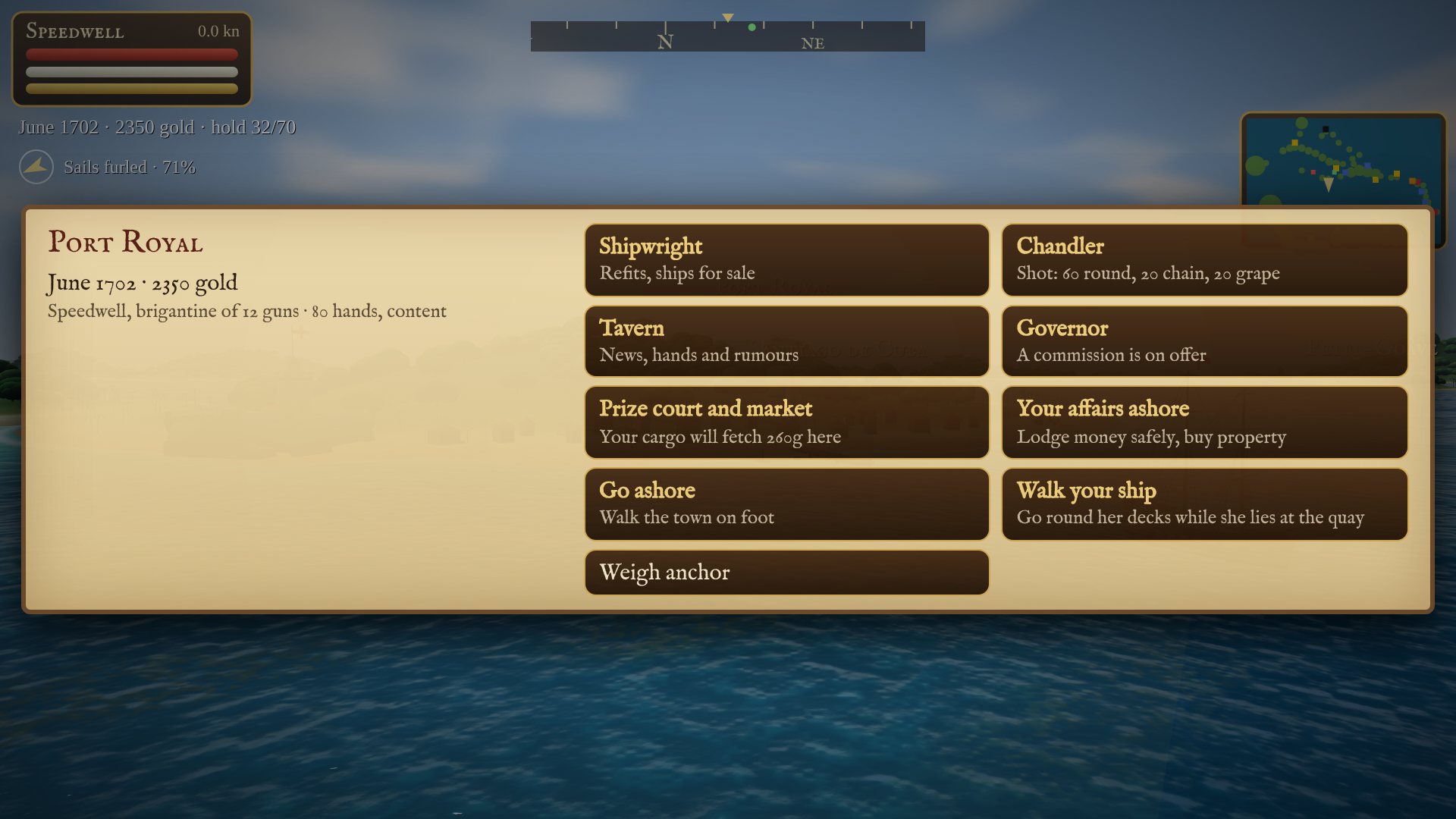
The game's seventeen ports are real places, set on the chart from their true positions.
- Port Royal, Jamaica, was the main English naval and privateering base. An earthquake in 1692 had dropped much of the town into the harbour, and it was still being rebuilt.
- Havana was where the Spanish treasure ships gathered before the passage home, and one of the strongest places in the Americas.
- Cartagena and Portobelo on the Spanish Main received the silver of Peru. A French squadron had sacked Cartagena only five years earlier, in 1697.
- Petit-Goâve, on French Saint-Domingue, had been a base for the buccaneers and still sent out corsairs.
- Willemstad, on Curaçao, was a Dutch trading port that did business with every nation, lawfully or not.
- Nassau was a poor and half-governed settlement. French and Spanish raiders burned it in 1703, and within a few years of the peace it became the best known pirate harbour of the age.
The treasure fleets
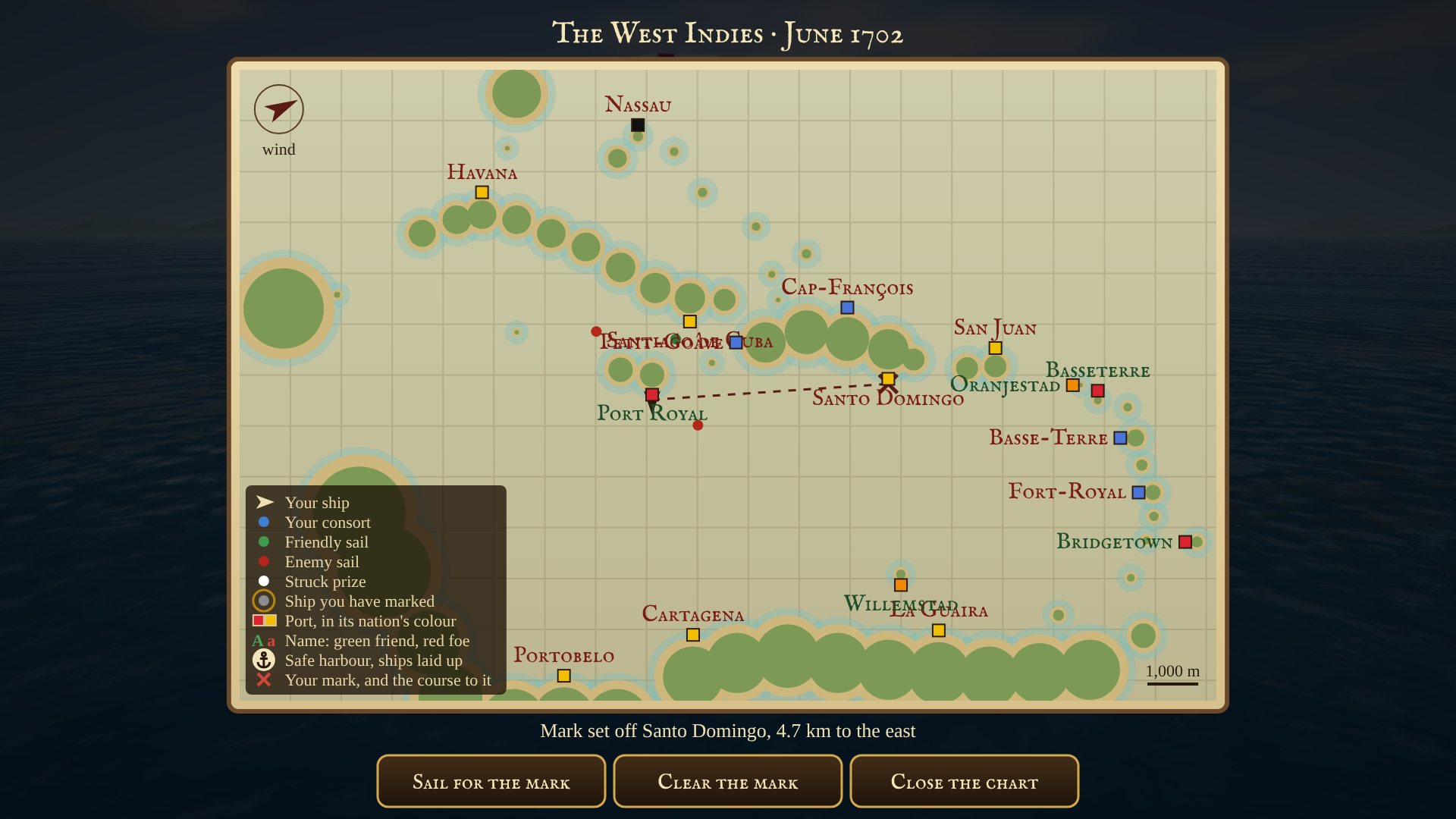
Spain moved American silver home in convoys. One fleet served Veracruz in Mexico. The other, the galleons, went to Cartagena and Portobelo for the silver of Peru, which came up the Pacific coast and across the isthmus by mule. Both made for Havana and then sailed for Spain together through the Florida Straits.
They were the richest ships in the world and every enemy of Spain knew their route. In October 1702 an Anglo-Dutch fleet destroyed a treasure convoy and its French escort in Vigo Bay, on the coast of Spain. In 1708 an English squadron under Charles Wager caught the galleons off Cartagena, and the flagship San José blew up with her cargo. In the game the galleons sail from Cartagena for Havana each spring under escort, and a captain with good information and enough force may try them.
The ships
- The Bermuda sloop was built of cedar, with one raked mast and a large fore and aft sail. Nothing in the islands went to windward as well, and privateers and smugglers favoured it.
- The brigantine carried two masts and enough men to fight. It was the usual choice for a private cruiser.
- The fluyt was a Dutch cargo carrier, roomy, cheap to run and lightly armed.
- The galleon carried Spanish treasure and trade: high at the stern, deep in the hold and slow.
- The frigate was a true warship, fast and well armed, and more than a small privateer should face alone.
Weapons of the time
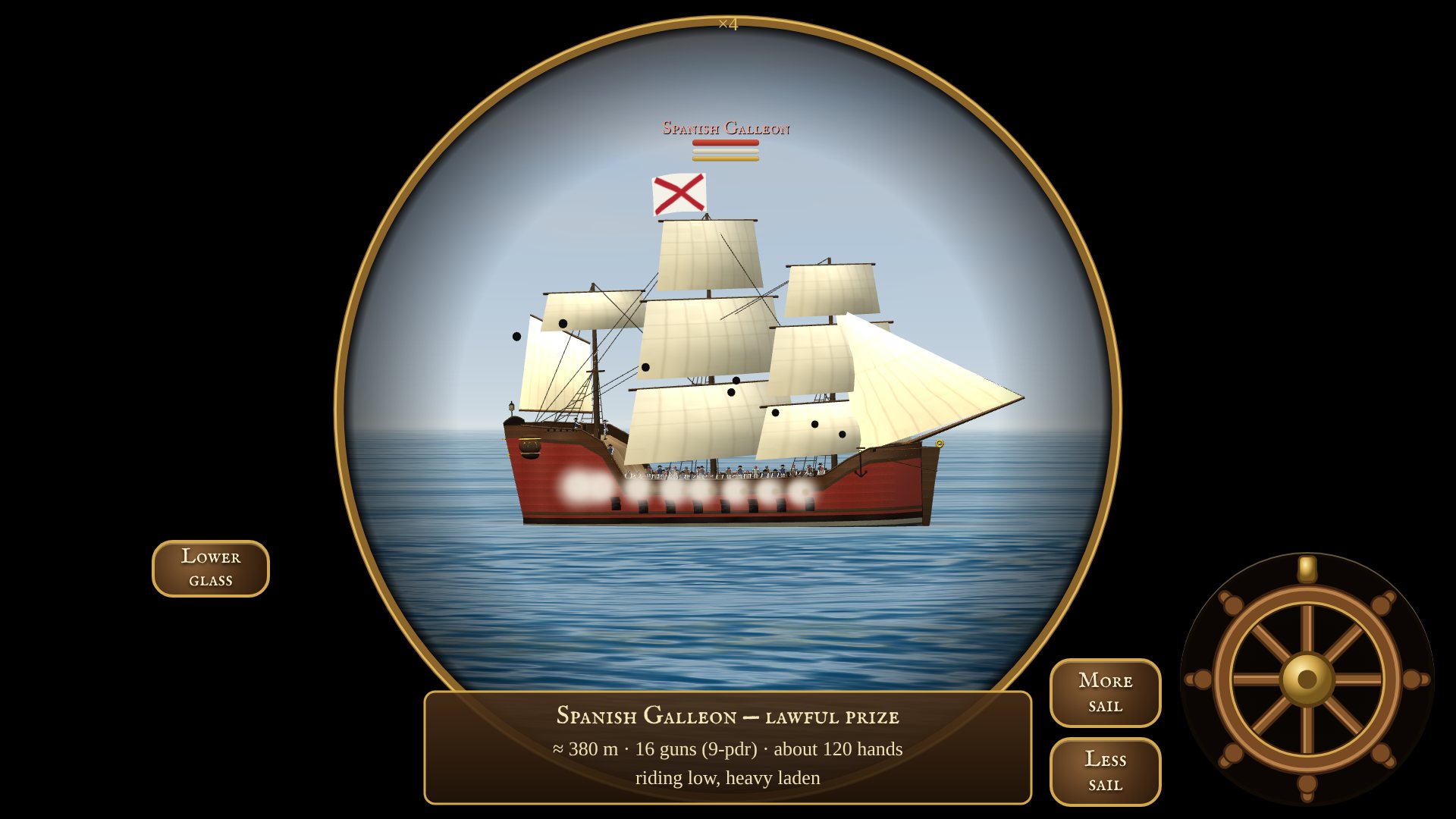
Ships' guns fired solid iron shot and nothing that exploded. Besides round shot there was chain or bar shot to cut rigging, and grape or case shot to sweep a deck. In a boarding, crews used muskets, pistols, cutlasses and boarding pikes, and some carried grenadoes, which were small iron or glass shells with a fuse, and stinkpots, which were jars of burning sulphur meant to drive men from a deck. Merchant ships sometimes fixed powder chests along the rail to be fired under a boarding party. A fireship was an old vessel packed with combustibles, sailed into an enemy and set alight at the last moment. All of these appear in the game with the limits they had in practice.
How it ended
Peace was signed at Utrecht in 1713. Letters of marque were worthless from that day. Thousands of seamen who had spent a decade learning to take ships were paid off in ports with no work for them. Some had been privateers under men such as Benjamin Hornigold and Henry Jennings, and many went on doing the only trade they knew, now without a commission. The years that followed, up to about 1725, are the ones people usually mean when they speak of the golden age of piracy.
The game follows the same course. Your career begins with a commission and the war, and when the peace comes you must decide what kind of captain you have become. Real people of the period are mentioned only in the news you read in port. Every ship and captain you meet at sea is invented.
To see how these things play, read about ship combat, what the simulation models, or the game as a whole.
Take her to sea
The game opens in this browser tab. On a phone, turn it sideways and switch the sound on.